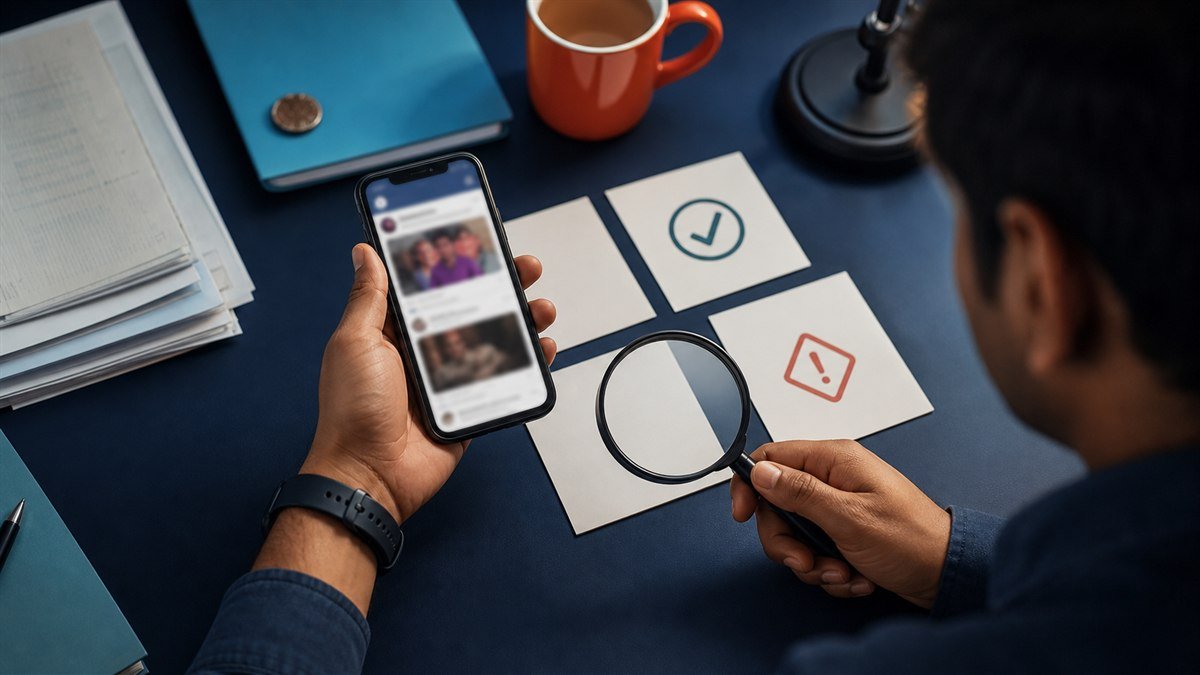
Use source checks, context and privacy awareness before sharing viral celebrity or entertainment claims.
Celebrity stories travel quickly because identity, emotion and social proof make them easy to share. The cost of a false claim can be real, even when the original post looks humorous or harmless. This guide explains a practical framework for Indian readers and highlights the decisions that deserve more attention than a headline or product promise.
The intended outcome is to pause, verify and discuss entertainment news without amplifying misinformation or invasion of privacy. The recommendations are educational and should be adjusted for personal health, financial circumstances, institutional rules, local conditions and professional advice where appropriate.
Why verify celebrity news needs a practical framework
A step-by-step approach
1. Find the earliest credible source
Trace screenshots and quotes back to an official statement, direct interview or accountable publication. This step should be tested against the reader’s real schedule, budget and responsibilities rather than an idealised scenario. Record what changes, what remains difficult and which part produces the greatest benefit.
2. Separate reporting from commentary
Notice whether the post provides evidence or only repeats another user’s reaction. This step should be tested against the reader’s real schedule, budget and responsibilities rather than an idealised scenario. Record what changes, what remains difficult and which part produces the greatest benefit.
3. Check date and original context
Old clips, fictional promotions and edited interviews are frequently presented as current events. This step should be tested against the reader’s real schedule, budget and responsibilities rather than an idealised scenario. Record what changes, what remains difficult and which part produces the greatest benefit.
4. Look for independent confirmation
Major claims should be supported by more than accounts copying the same unverified post. This step should be tested against the reader’s real schedule, budget and responsibilities rather than an idealised scenario. Record what changes, what remains difficult and which part produces the greatest benefit.
5. Consider privacy and harm
Avoid sharing private addresses, medical speculation, children’s details or content obtained through harassment. This step should be tested against the reader’s real schedule, budget and responsibilities rather than an idealised scenario. Record what changes, what remains difficult and which part produces the greatest benefit.
India-specific questions to ask before acting
Common mistakes to avoid
- Treating a trending hashtag as proof. Pause and identify the assumption behind this choice before spending more time or money.
- Sharing a screenshot without a source link. Pause and identify the assumption behind this choice before spending more time or money.
- Diagnosing health or relationships from a clip. Pause and identify the assumption behind this choice before spending more time or money.
- Assuming deletion proves guilt. Pause and identify the assumption behind this choice before spending more time or money.
A seven-day action plan
- Day one: write the outcome and list the constraints that cannot be ignored.
- Day two: collect information from primary, official or accountable sources.
- Day three: compare no more than three realistic options using the same criteria.
- Day four: test the smallest safe version of the first step.
- Day five: note cost, time, friction and any unexpected concern.
- Day six: discuss the choice with a trusted person or qualified professional when the risk is meaningful.
- Day seven: keep, change or stop the plan based on evidence rather than sunk cost.
Continue reading on Techsslaasha
For a deeper view of this subject, read How Streaming Is Changing Entertainment Choices in India and India’s Creator Economy: Careers, Risks and Opportunities. A related perspective appears in Smart Weekend Trip Planning in India, connecting this decision with another part of modern life in India.
Frequently asked questions
Is a verified social account always a reliable source?
It can confirm that the account posted something, but the claim itself may still require evidence. Readers should confirm time-sensitive requirements with qualified or official sources before acting.
How can edited videos be identified?
Look for the full recording, abrupt cuts, missing context and credible reporting about the original event. Readers should confirm time-sensitive requirements with qualified or official sources before acting.
Should rumours be shared with a disclaimer?
A disclaimer does not remove the amplification effect; if the claim cannot be verified, not sharing is usually safer. Readers should confirm time-sensitive requirements with qualified or official sources before acting.
Final takeaway
How to Evaluate Viral Celebrity News Responsibly becomes easier when the reader stops looking for a universal answer and starts using a transparent process. Define the need, compare realistic options, protect against the most important risk and review the result after real experience.
Found this useful? Explore more practical reporting from the Entertainment desk.
Browse Entertainment